 English
 Russian
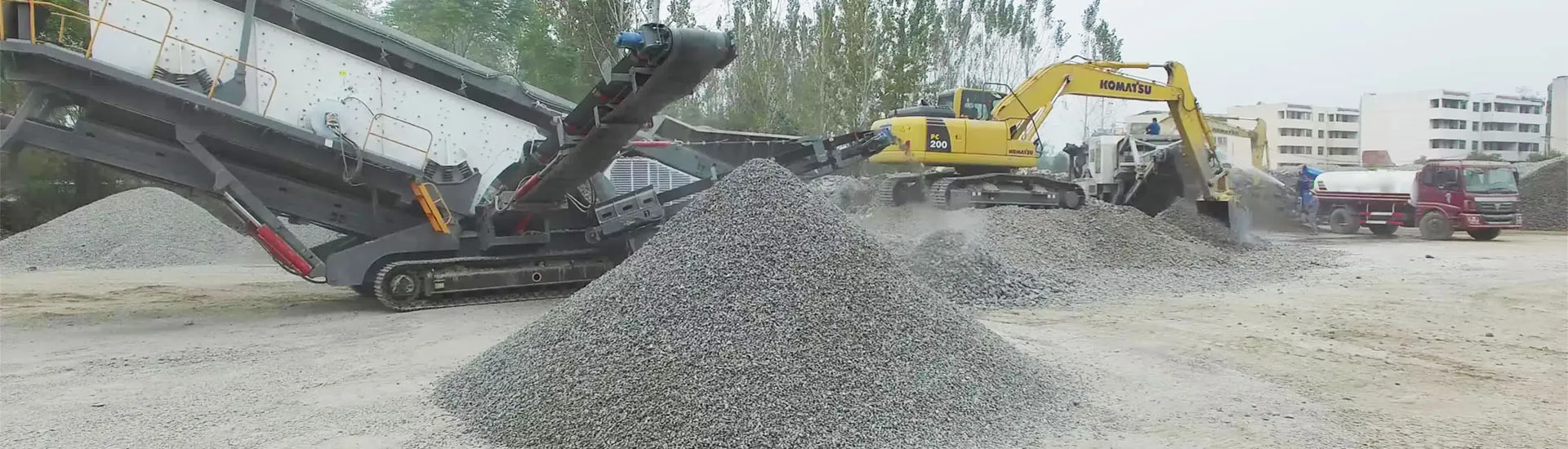
Principles for Designing the Production Process Flow
A well-designed production process must fully consider process rationality, reliability, advanced technology, economy, and mutual compatibility. The optimal layout is designed based on the required processing scale, rock characteristics, and finished aggregate specifications. The process flow generally follows these key principles:
1. Crushing Ratio
The crushing ratio is a key metric for measuring crusher effectiveness, defined as the ratio of feed size to product size, indicating the reduction factor. It can be calculated by:
The ratio of the maximum feed size to the maximum product size.
Using average particle sizes.
As the crushing ratio is a primary factor in determining the number of crushing stages, finer product requirements lead to more stages. Recommended ratios are: Primary Crushing: i=3-5, Secondary Crushing: i=4-5, Tertiary Crushing: i=5-8. This ensures each stage operates efficiently, leading to an optimal crushing circuit.
Failure to achieve the required ratio at any stage will pressure downstream crushers, increase potential system failure points, and reduce operational reliability. Therefore, the selection and distribution of the crushing ratio is a fundamental principle.
2. Production Scale
For large-scale mechanized sand plants, economy is the primary indicator. The availability of numerous equipment models allows for multiple design schemes. Comparing these schemes helps select the most economical solution that meets production demands, resulting in significant investment savings and lower operating costs.
For smaller-scale systems, process simplicity is prioritized. A two-stage crushing circuit is preferred over a three-stage one wherever possible, utilizing the fewest number of crushers, screens, and conveyors to achieve design objectives.
3. Product Shape & Size
Product Shape refers to particle geometry, while Product Size refers to particle dimensions. Both are critical quality indicators. For concrete aggregate, there are not only strict size requirements but also a demand for a cubic particle shape.
Different crushers produce different particle shapes, meaning product shape is directly related to the selected crusher's performance and the material's properties (e.g., laminated rocks tend to produce flaky particles).
4. Crusher Performance
The type of crusher directly influences the crushing process flow and product gradation:
Crushers with high reduction ratios can reduce the number of required crushing stages.
Crushers utilizing inter-particle compression (like cone crushers) produce fewer flaky particles.
Impact crushers, which use kinetic energy, often produce more cubicle products.
"Rock-on-Rock" Vertical Shaft Impact (VSI) crushers yield better particle shapes but have lower sand production efficiency compared to "Rock-on-Iron" configurations.
5. Material Properties
The material's crystal structure and compressive strength are critical factors influencing the process design and equipment selection. Materials with high compressive strength are difficult to crush and require powerful crushers, which often limits the available options.
Furthermore, materials with a granular crystal structure tend to produce cubic particles, while those with a laminated structure produce flaky particles, often necessitating an additional "shaping" step in the process.
Key Equipment Selection
1. Primary Crushing
Primary crushing is typically an open-circuit process, handling run-of-quarry material. Common equipment includes Gyratory Crushers and Jaw Crushers.
Gyratory Crusher: Handles very large feed sizes and high capacities, suitable for all rock types. It offers stable operation and smooth feeding. Its drawbacks include a large layout footprint and high initial investment. It is the ideal choice for capacities ≥ 1200-1500 t/h, as it reduces the number of units and simplifies the flow. Its advantages become more pronounced in larger processing systems.
Jaw Crusher: Suitable for all rock types. However, due to its design with a non-working stroke, it has a relatively lower capacity and produces poorer particle shape with a higher flaky content. It is a cost-effective choice for capacities < 1000 t/h where aggregate shape requirements are not strict. Its smaller crushing ratio increases the load on subsequent stages, and the poor particle shape often requires a shaping step. It is the preferred primary crusher for small and medium-sized quarries.
2. Secondary & Tertiary Crushing
Secondary and tertiary crushing typically operate in a closed circuit with a screen. Common equipment includes Impact Crushers and Cone Crushers (including Spring Cone Crushers, Single-Cylinder Hydraulic Cone Crushers, and Multi-Cylinder Hydraulic Cone Crushers).
Impact Crusher: Known for producing excellent particle shape and having a lower initial investment. It is widely used but is only suitable for medium-hard, low-abrasiveness rocks; otherwise, wear costs increase significantly, reducing its economic viability. While hard rock impact crushers exist, their operating costs remain high, making Cone Crushers generally superior for hard rock applications.
Cone Crusher: Breaking force and reduction ratio vary by type, with a clear industry trend toward hydraulic models. Multi-cylinder hydraulic cone crushers generally offer higher overall performance. The choice between single and multi-cylinder depends on the overall flow: use Multi-Cylinder for higher reduction ratios (which can reduce the number of stages and lower system cost) and for hard rock crushing (typically producing <18% flaky content). Use Single-Cylinder for processing general rocks.
3. Sand Making (Sand Milling)
Sand production methods are generally categorized into Wet, Dry, and Semi-Dry processes. Common equipment includes Vertical Shaft Impact (VSI) Crushers and Rod Mills.
Vertical Shaft Impact (VSI) Crusher: The most widely used sand making equipment. It offers high production efficiency, good particle shape, low operating cost, and provides a shaping effect. The sand's fineness modulus is typically around 3.0, with a less-than-ideal gradation. It can be screened into fractions (e.g., 2.36-4.75mm, 0.6-2.36mm, <0.6mm) and then blended to meet specific gradation requirements. Adding a controlled amount of fines from a Rod Mill is another effective method.
Rod Mill: Often used in wet processes (types include overflow, open-ended, and peripheral discharge). It produces excellent particle shape and allows for easy adjustment of the fineness modulus. Its main disadvantages are low efficiency, high noise levels, and high operating costs. In projects demanding very high-quality sand, a combined process using a VSI crusher and a Rod Mill is common, where the Rod Mill primarily acts as a gradation adjustment unit.
Others: Other crushers like vertical shaft fine impact crushers and reversible hammer crushers can produce sand but are only suitable for medium-hard or softer materials. The preferred and most efficient choice for dedicated sand making is the VSI Crusher.
4. Sand Washing & Recovery Equipment
Common types include Wheel Sand Washers, Spiral Sand Washers, Fine Sand Recovery Units, and Combined Sand Washing & Recovery Units.
5. Auxiliary Equipment Selection
This category includes Feeding, Screening, Bins/Storage, Conveying, and Automation Control.
Feeding Equipment: Includes Apron Feeders, Wobbler Feeders, Electromagnetic Vibrating Feeders, Reciprocating Feeders, and Vibrating Grizzly Feeders (VGF). The Vibrating Grizzly Feeder (VGF) is widely used due to its high feed capacity, ability to handle material with high soil and moisture content, and its combined pre-screening and feeding action which removes impurities.
Vibrating Screens: Major types include Circular Motion Screens (for large/medium coarse material), Linear Motion Screens (for medium/fine material and dewatering), Elliptical Motion Screens (for large/medium material), Multi-Combination Screens (for small, sticky, and high-moisture materials with high fines content), Sieve Bends (for fine material screening and dewatering), and High-Frequency Dewatering Screens (for dry or wet classification of medium/fine particles). Selecting the correct screen and mesh type is crucial for achieving high efficiency and low operating costs.
Bins/Storage: Must be designed to ensure continuous, stable, and full-load operation of the equipment, while also allowing for convenient maintenance access.
Automation Control: Keeps crushers operating at full load, optimizes overall system performance, enables self-protection mechanisms, reduces labor costs, lowers operating expenses, and provides crucial monitoring to quickly identify and resolve faults, minimizing downtime.
Conclusion
Selecting a reliable, technologically advanced, and economical sand and aggregate production process is a complex systems engineering task. It requires careful consideration of feed size, finished product requirements, rock properties, and the rational matching of all crushing, screening, and auxiliary equipment, supported by an effective automation control system. Only a well-planned process flow and proper equipment configuration can result in an efficient, high-yield, and economically viable sand production line.